Individual learningNon-co-locatedDesktop + XRAttention support
Core distinction
Two situations. Two support goals.
The practical question is simple: does the external event require the learner to stop the lesson? The answer changes what helpful system behaviour looks like.
Support goal
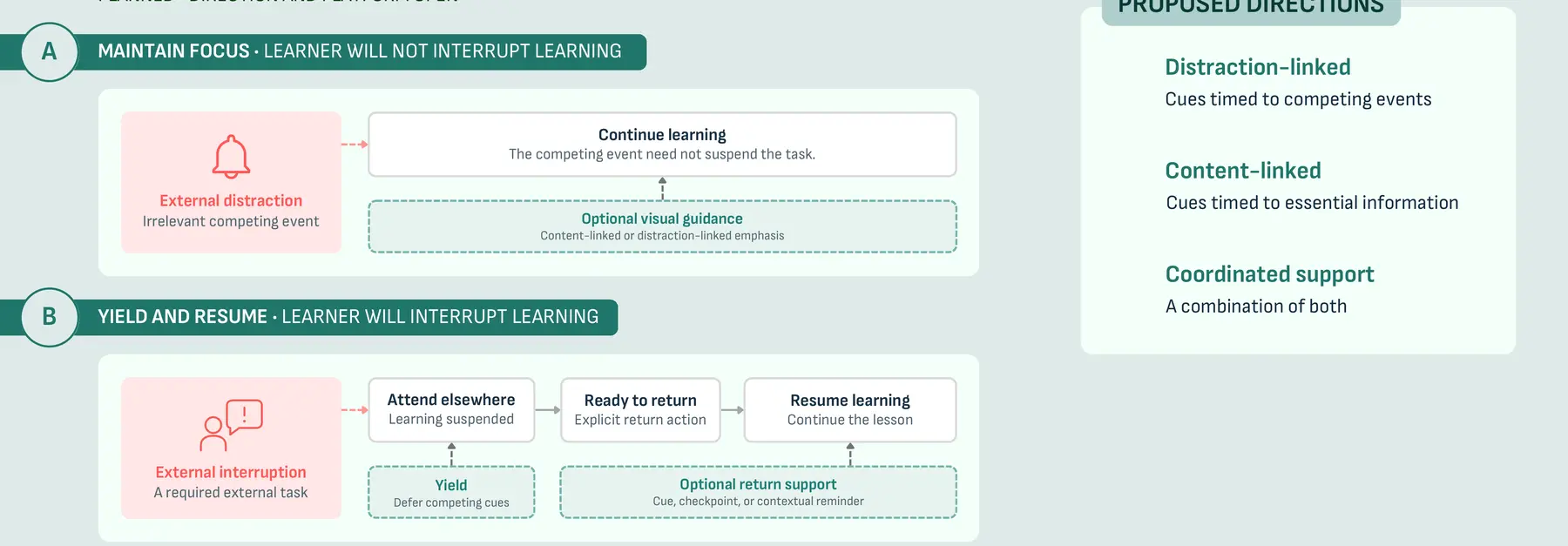
Protect the learning task without creating another distraction.
Optional visual guidance can emphasize relevant content around a competing event, but the intervention itself must not add unnecessary workload or obstruction.
1Competing eventirrelevant to the lesson
→
2Learning continuestask stays active
→
3Optional supportonly if it helps
What this dissertation is testing
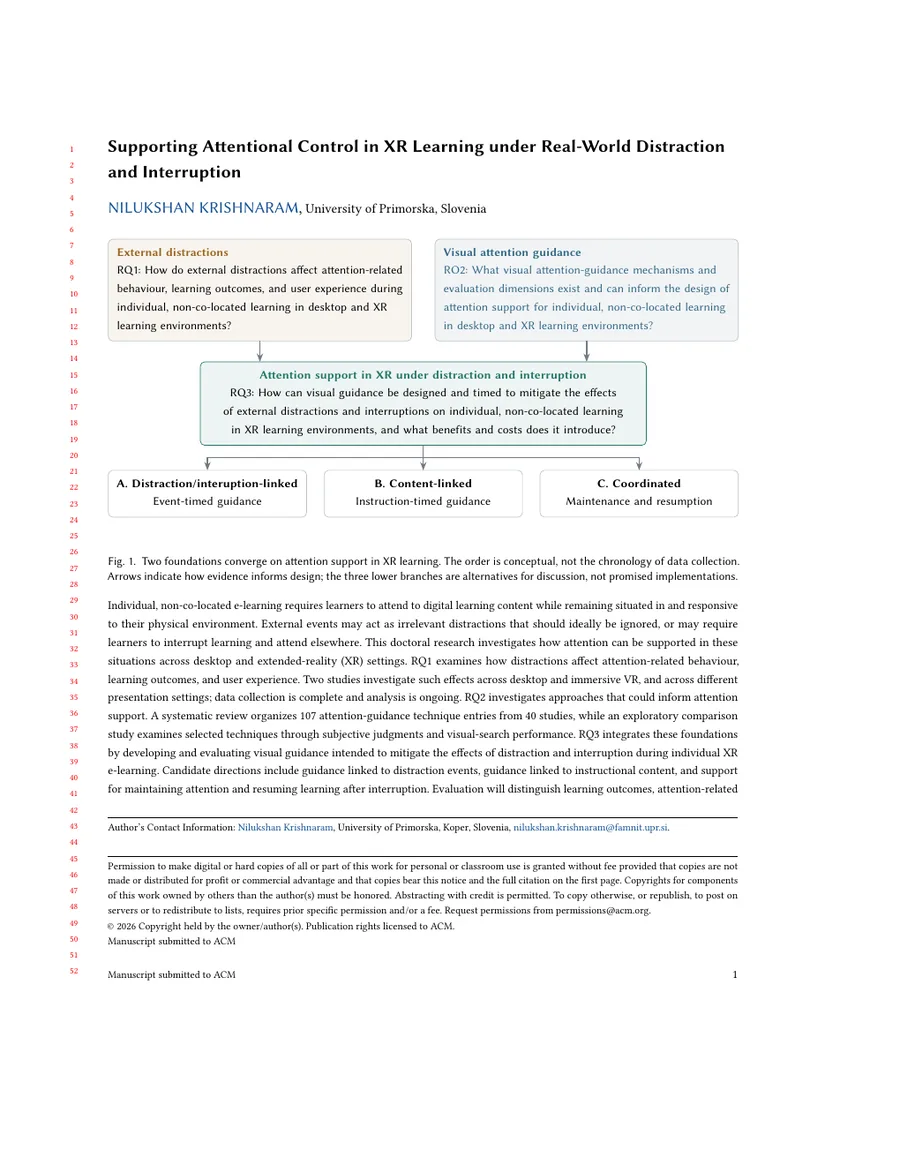
RQ1 measures how realistic external distractions affect learning and experience. RQ2 maps the available attention-guidance design space. RQ3 combines both foundations to test when guidance should appear, what it should communicate, and whether its benefits outweigh its costs.
Dissertation overview
Three questions form one design pipeline.
First understand the competition for attention. Then understand the available guidance mechanisms. Finally, use both foundations to design and evaluate support in XR learning.
RQ1Analysis ongoing
Understand external distraction
How do external distractions affect attention-related behaviour, learning outcomes, and user experience during individual, non-co-located learning in desktop and XR learning environments?
ProducesEvidence about susceptibility, learning effects, and observable responses.
What visual attention-guidance mechanisms and evaluation dimensions exist and can inform the design of attention support for individual, non-co-located learning in desktop and XR learning environments?
ProducesA design vocabulary and a multi-metric way to evaluate guidance.
Evaluate attentional support under distraction and interruption
How can visual guidance be designed and timed to mitigate the effects of external distractions and interruptions on individual, non-co-located learning in XR learning environments, and what benefits and costs does it introduce?
IntegratesWhat the user is experiencing + what the system can do + when support should appear.
What pulls attention away — and does presentation mode change the effect?
A formative student survey informed a shared set of auditory scenarios. Two studies then examined distraction across desktop, immersive VR, and three Apple Vision Pro presentation environments.
102students in the formative survey
Survey-informed distraction scenarios
Students reported distractions experienced during face-to-face and online learning. Four auditory scenarios were selected for controlled experiments.
Phone notificationsRepeated alert sounds
Keyboard typingContinuous nearby typing
Scripted phone callRingtone + conversation
Construction noiseProlonged environmental noise
Exposure ≠ confirmed interruption
A distractor can compete for attention without proving that the learner disengaged or missed content.
Episode type is time-confounded
The four distractors differ in timing and duration, so episode-level comparisons are descriptive unless the design supports stronger inference.
Gaze ≠ attention ≠ comprehension
Eye tracking is useful behavioural evidence, but looking at content does not establish cognitive engagement or learning.
02
Understand attention guidance
How have researchers directed visual attention — and how should those techniques be compared?
The attention-guidance work maps a fragmented design space, gives it a shared vocabulary, and then compares selected techniques under one common visual-search task.
01
Fragmented design space
Arrows, labels, blur, flicker, binocular modulation, highlights, and many other mechanisms had been difficult to compare directly.
02
Shared taxonomy
107 technique entries are organized by perceptibility, mechanism, platform, visual variables, and Gestalt principles.
03
Common-task study
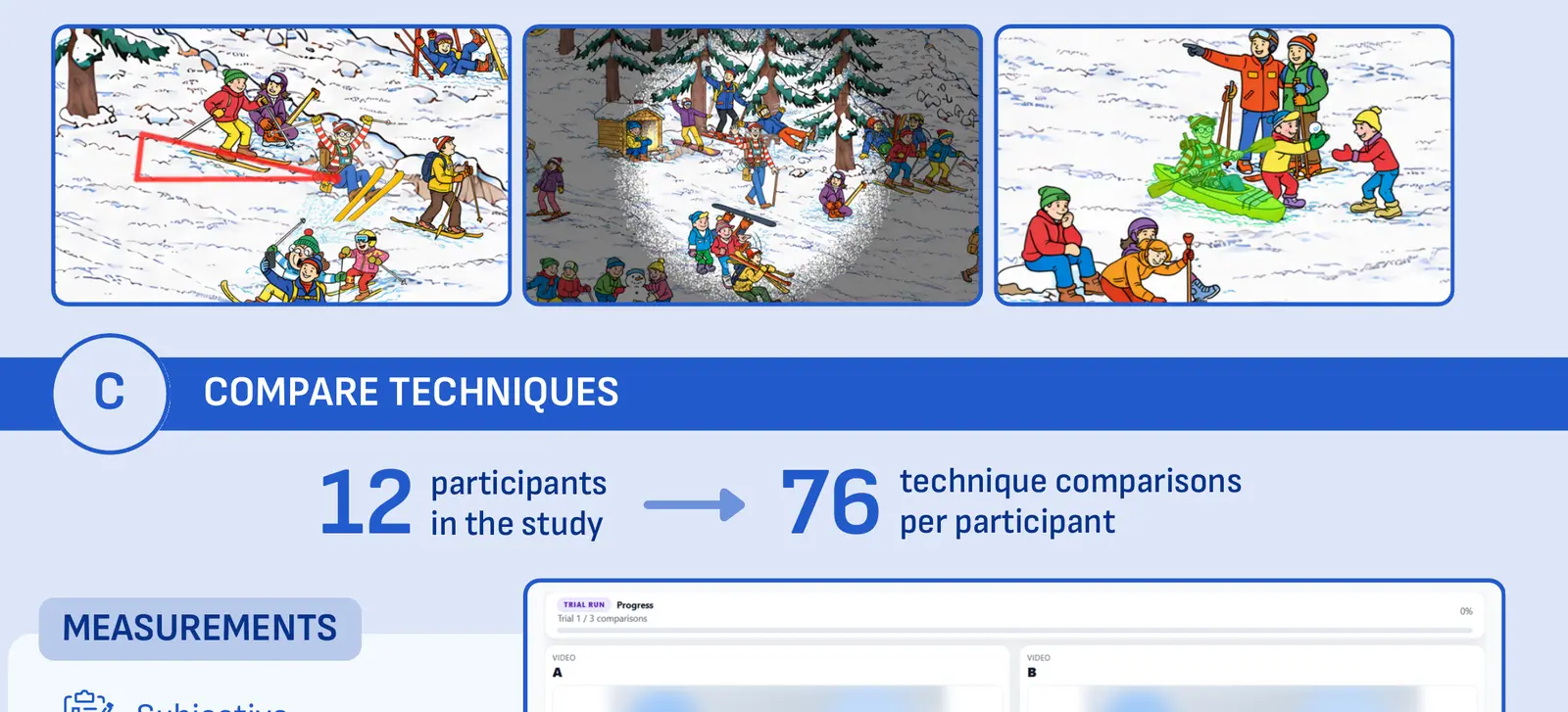
18 paper-informed conditions were recreated in the same visual-search task and compared with subjective and gaze-based measures.
04
Profile, not one score
Noticeability, preference, findability, fixation success, timing, and replay effort can diverge.
3,560database records
→
2,486records screened
→
96full texts assessed
→
40included studies
107technique entries
24technique families
85 / 22perceptible / imperceptible
54 / 30 / 23AR / VR / traditional
Taxonomy explorer
Describe a technique before trying to rank it.
Select a dimension to see what it contributes to the design vocabulary.
Design anatomy
What changes in the scene, and how is attention organized?
Paper-informed examples from the common-task study. The full explorer includes the complete 18-condition set.
The study compares noticeability, preference, perceived findability, target fixation, guidance-relative timing, and replay effort. It is exploratory: the goal is to reveal trade-offs, not declare a universal winner.
Why 76 adaptive comparisons?
With 18 conditions, exhaustive unique pairing would require 153 comparisons per participant. The study used a fixed budget of 76. Early selection prioritised broad exposure, then minimum exposure, followed by more targeted comparisons. Noticeability drove the adaptive schedule; preference was collected on the same displayed pairs.
Trade-off explorer
Four examples of why one “best” score is misleading.
Choose a profile.
03
Evaluate attentional support
How should XR support focus and return to learning?
RQ3 is not a single predetermined cue. It is a design problem with two separable choices: what guidance communicates and when or whether it appears.
Mechanism
What changes or is communicated?
For example: visual emphasis, a cue, a checkpoint, or a contextual reminder.
+
Delivery policy
When should the support appear?
For example: around a competing event, when essential content appears, or only on return.
=
Intervention
A bounded support strategy to evaluate.
The final study should isolate benefit from the extra demands introduced by assistance.
Current design space
Maintain focus when learning should continue. Yield and support return when it should not.
The distinction is deliberately behavioural rather than technological: the same XR system may need different policies depending on whether the external event is irrelevant or requires the learner's attention.
Candidate direction explorer
Three directions currently under discussion
Select a direction to see the mechanism, timing policy, comparison, and main evaluation question.
Potential benefits
Does support improve learning or continuation?
Knowledge / learning outcomes
Task continuation and re-entry
Attention-related behaviour
Perceived helpfulness
Potential costs
What additional demands does assistance introduce?
Workload
Annoyance
Visual obstruction
Interference with required external activity
What counts as convincing evidence?
Gaze return and perceived helpfulness should be assessed separately from learning outcomes. Comparisons intended to isolate visual guidance should match instructional information and viewing time. Recaps and replay alter the information or exposure available, and visual emphasis alone cannot recover inaudible narration.
Dissertation roadmap
What is complete, what is being analysed, and what comes next?
1
Foundation
Review and taxonomy
40 studies, 107 technique entries, 24 families, five classification dimensions.
2
Exploratory benchmark
Common-task technique comparison
18 conditions, 12 participants, adaptive pairwise comparison with subjective and gaze-based outcomes.
3
Current
Finish external-distraction analyses
Study 1 and Study 2 data collection is complete. Analysis is ongoing, including time/content-aware questions where the data support them.
4
Next
Select and pilot one support direction
Use RQ1 and RQ2 evidence, symposium feedback, lesson fit, and XR constraints to select a bounded mechanism + delivery policy.
5
Evaluate
Test benefit and cost
Evaluate one attention-support intervention and determine whether a further timing or resumption study is warranted.
Questions taken to the Doctoral Symposium
01
Thesis coherence
Do the distraction studies and guidance work form a coherent contribution to attentional control in XR learning?
02
Research direction
Which offers the strongest next step: event-linked, content-linked, or coordinated maintenance and resumption?
03
Evaluation
What evidence demonstrates meaningful learning benefit, and which assistance costs matter most?
04
Scope
What can one focused intervention study establish, and what would justify an additional study?
Research context
Selected prior work shaping the dissertation
The current Doctoral Symposium paper positions the thesis across interruption science, XR learning, attention guidance, and resumption support.
This site is grounded in the current ISS 2026 poster and six-page extended abstract for the Doctoral Symposium, with additional detail from the ongoing dissertation work.
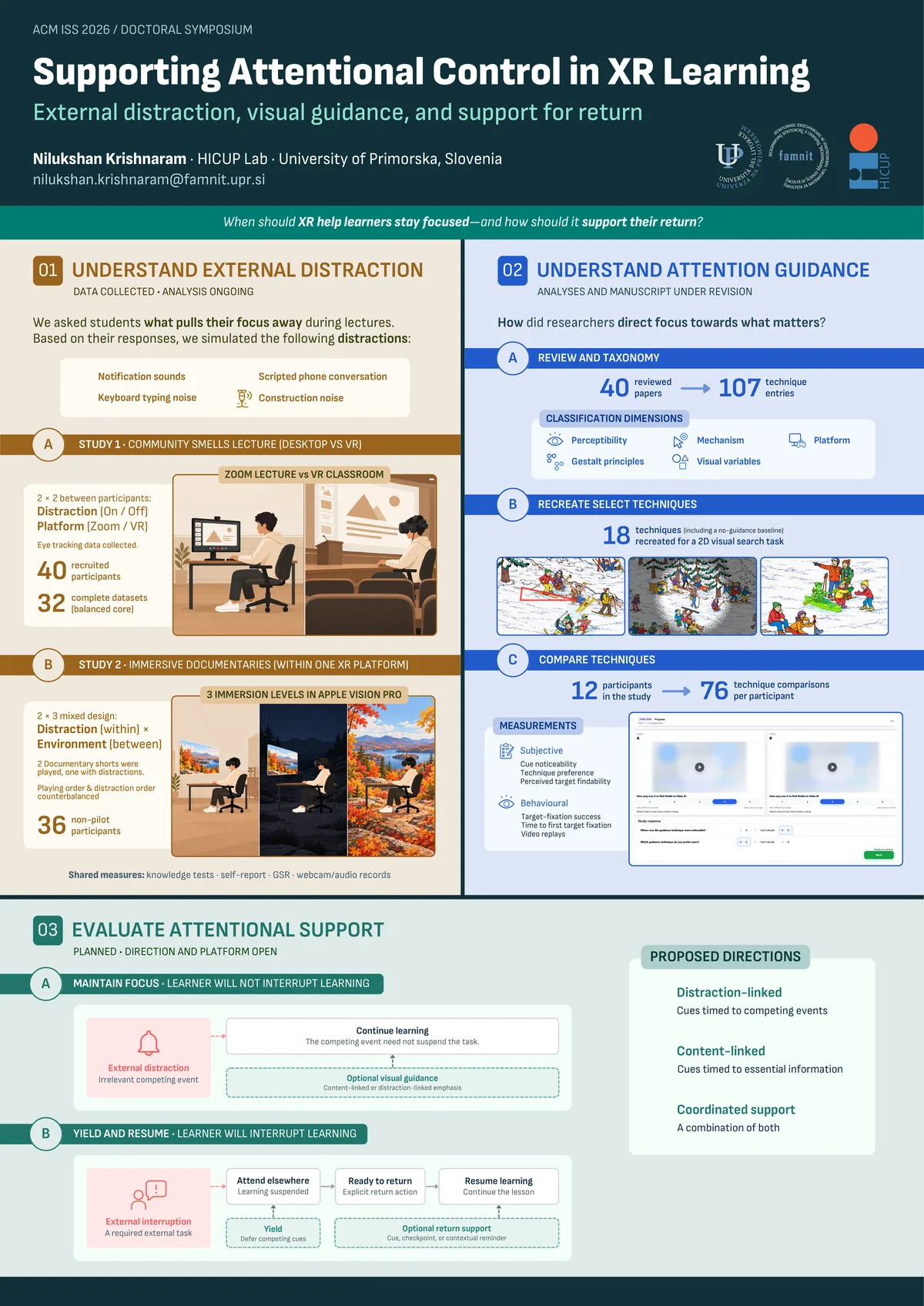
Poster
Supporting Attentional Control in XR Learning
Visual overview of RQ1, RQ2, and proposed RQ3 directions.